- AQH Weekly Deep Dive
- Posts
- US Bond Markets & Bond Total Return Swaps
US Bond Markets & Bond Total Return Swaps
AlgoQuantHub Weekly Deep Dive

Nicholas Burgess
June 13, 2025
Welcome
Welcome to AlgoQuantHub’s Weekly Deep Dive into Algo Trading & Quant Research!
AlgoQuantHub includes the latest hands-on quant tutorials, videos and research, helping you bridge the gap between theory and real-world quant practice. All delivered by this newsletter! Each week I will deliver a targeted deep dive into a feature topic.
Last week for our market’s article we asked if the US bond market is in a crisis situation. This week we consider the impact of Trump’s ‘Big Beautiful Bill’ and ratings downgrades on US Bond markets.
For last week’s technical article we discussed Algorithmic Adjoint Differentiation (AAD). This week we look at Bond Total Return swaps as a tool to maximize profits and minimize cost i.e. increase leverage and reduce capital costs using margin.
Digital Download Voucher
In this week’s newsletter we give readers a digital download voucher for use in AlgoQuantHub’s digital download store for the first 25 users. https://payhip.com/AlgoQuantHub.
25% off total order amount
Code: JM9H2RZXK1
Table of Contents
Feature Article - US Bond Market Outlook and the ‘Big Beautiful Bill’
President Trump’s “One Big Beautiful Bill” (OBBB), combined with recent U.S. credit rating downgrades, highlights mounting fiscal challenges and their significant implications for the U.S. bond market. Moody’s downgrade of the U.S. sovereign credit rating from Aaa to Aa1—joining earlier downgrades by S&P in 2011 and Fitch in 2023—reflects concerns over persistent large deficits and rising interest costs amid political gridlock on debt management. The OBBB extends the 2017 tax cuts, raises the federal debt ceiling by $4 trillion, and despite historic mandatory spending cuts, is projected to widen the 10-year budget deficit by approximately $2.6 trillion, pushing the debt-to-GDP ratio toward 134% by 2035.
Market Reactions and Outlook
Treasury Yields: The announcement triggered an initial spike in Treasury yields, with the 30-year briefly surpassing 5%, as investors priced in increased supply and fiscal risk. Yields have since stabilized but remain sensitive to ongoing fiscal developments.
Equities: Despite the downgrade and fiscal concerns, equity markets have shown resilience, buoyed by retail investor inflows and optimism about pro-growth policies, though volatility persists.
Bond Auctions: Recent weak demand for longer-dated Treasuries, such as 20-year bonds, signals investor caution and potential upward pressure on borrowing costs if deficits remain elevated.
The downgrade and OBBB’s fiscal impact underscore structural challenges, including rising debt service costs projected to consume nearly 30% of federal revenue by 2035 and continued reliance on foreign demand for U.S. debt. While the dollar’s reserve currency status provides some buffer, sustained deficits risk eroding investor confidence, potentially leading to tighter financial conditions and increased yield volatility. For bond markets, the interplay between growing supply driven by fiscal deficits and economic growth-inflation dynamics will be critical in determining risk premiums and yield curve behaviour in the years ahead.
Further reading
https://www.pbs.org/newshour/show/breaking-down-trumps-big-beautiful-bill-and-its-impact-on-the-deficit-and-national-debt
Feature Video - Bond Total Return Swaps
Subscribe to AlgoQuantHub’s Quant YouTube Channel!
In this video “Bond Total Return Swaps - Maximize Profits & Minimize Costs” I review Bond Total Return Swaps (TRS) outlining how it is used to gain leveraged exposure to a fixed income assets on margin. This provides a capital efficient way to invest in fixed income securities. The video gives a deep dive into Bond TRS pricing and how to price the bond coupons, performance and loss given default elements. I explain how to evaluate future bond prices using a ‘Risk Neutral’ approach and incorporate survival and default probabilities into all calculations. Have Fun!
Feature Download- Fixed Income Training Bundle
Visit AlgoQuantHub’s Digital Download Store!
The Fixed Income Training Bundle offers a clear and practical overview of key fixed income products. You’ll learn how to price US Treasury Bonds accurately and match real market prices, as seen on trading venues such as Bloomberg. The bundle also covers Bond Total Return Swaps which are often used for building synthetic Money Market and Bond ETFs. We also review asset swaps, which enable investors to borrow funds and invest in bonds simultaneously. You’ll also gain practical insights into pricing Credit Default Swaps and Quanto Credit Default Swaps—essential tools for managing credit risk in bond portfolios. Together, these modules provide a solid foundation for understanding the fixed income markets.
Includes: US Treasury Bond Pricing, Bond Total Return Swaps, Asset Swaps, Credit Default Swaps and Quanto Credit Default Swaps.
Feature Book - Low Latency Interest Rate Markets
Discover the cutting-edge insights in Low Latency Interest Rate Markets: Theory, Pricing and Practice by Nicholas Burgess, a seasoned quant with over two decades of experience at leading financial institutions. This book expertly bridges the gap between theoretical models and real-world electronic interest rate trading, addressing the urgent need for speed, precision, and efficiency in today’s trillion US dollar global interest rate market.
The book is structured into two comprehensive parts: Theory and Pricing & Practice. The first part introduces the fundamentals of interest rate markets, products like swaps and credit derivatives, yield curve construction, and the impact of benchmark reforms such as LIBOR transition. The second part offers practical case studies on swap pricing, asset swap structuring, and advanced techniques for ultra-fast, low latency calculations.
Click on the image below for more info!

Feature Book - Python for Algorithmic Trading
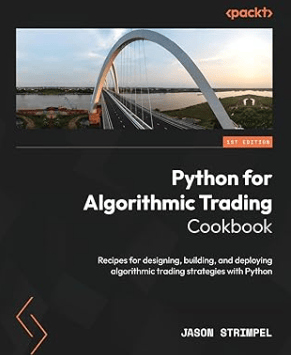
Jason Strimpel’s Python for Algorithmic Trading is a practical and accessible guide for traders and quants looking to harness Python for developing and automating trading strategies. The book covers essential topics such as data handling, strategy design, backtesting, and execution, making it a solid resource for those aiming to build systematic trading systems from the ground up. Strimpel’s clear explanations and hands-on examples help bridge the gap between theory and real-world application, making it suitable for both beginners and more experienced practitioners.
Notably, the book features a well-structured section on Interactive Brokers’ Python API, providing detailed guidance on setting up connectivity, accessing market data, and executing trades programmatically. This part is particularly valuable for anyone looking to automate trading workflows using IB’s powerful but complex API, offering practical tips to overcome common challenges and get started efficiently.
Click on the image below for more info!
Useful Links
Quant Research
Links to my Quant Research
SSRN Research Papers
https://ssrn.com/author=1728976
GitHub Quant Research
https://github.com/nburgessx/QuantResearch
Learn about Financial Markets
Linked to learning resources for Financial Markets
Subscribe to my Quant YouTube Channel
https://youtube.com/@AlgoQuantHub
Algorithmic Trading & Quant Research Hub
https://payhip.com/AlgoQuantHub
Follow me on Linked-In
https://www.linkedin.com/in/nburgessx/
Explore my Quant Website
https://nicholasburgess.co.uk/
Read my Quant Book - Low Latency IR Markets
https://github.com/nburgessx/SwapsBook
AlgoQuantHub Newsletters
The Edge
The ‘AQH Weekly Edge’ newsletter for cutting edge algo trading and quant research.
https://bit.ly/AlgoQuantHubEdge
The Deep Dive
Deep dive into the world of algo trading and quant research with a focus on implementation and getting things done for real.
https://bit.ly/AlgoQuantHubDeepDive
 |  |
Algorithmic Trading - Interactive Brokers (IBKR)
This broker has an excellent platform that supports both live, and simulation accounts. Interactive Brokers stands out as a top broker choice for algorithmic trading thanks to its extensive, free-to-use API offering that enable seamless automation, real-time market data access, and comprehensive account management. Coupled with deep market liquidity, efficient execution, and some of the industry’s lowest fees, IBKR provides a robust, scalable platform ideal for both individual quants and institutional algo trading strategies.
IBKR Home
https://www.interactivebrokers.com/
https://www.interactivebrokers.co.uk/en/home.php
Trading View Charting Software
https://www.tradingview.com/chart/
IBKR Trader Workstation (TWS) API Documentation
https://www.interactivebrokers.com/campus/ibkr-api-page/twsapi-doc/#api-introduction
IBKR Python API Guide
https://www.interactivebrokers.com/campus/ibkr-quant-news/interactive-brokers-python-api-native-a-step-by-step-guide
Feedback & Requests
I’d love your feedback to help shape future content to best serve your needs, you can reach me at [email protected]